A Ray of Hope
Kazakhstanskaya Pravda, January 16, 2018
The dilapidated building housing the “Nur” family children’s home in Talgar is in urgent need of major repairs.
Asset Kalymov, Almaty Region
In August this year, the “Nur” family children’s home in Talgar will mark its 20th anniversary. Over the years, the institution, which has raised 750 (!) foster children, has existed entirely on donations from sponsors and is in urgent need of government support. The funds barely cover food, clothing, medicines, utility bills, and staff salaries.
The staff consists of 10 people: caregivers, cooks, security guards, a dishwasher, and a cleaner. Each month, maintaining the home costs around 1.5 million tenge. Approximately half of this amount is spent on gas, heating, and electricity.
The building has a total area of more than 2,000 square meters. It was once an abandoned kindergarten on the outskirts of Talgar. Back in 1998, a teacher from Almaty, Tuyak Eskozhina, and her husband, Anuarbek Baysarin, sold their city apartment, leased this old building from the state, and opened one of the first family-type children’s homes in the country. Having raised three sons of their own, this compassionate couple radically changed their plans for the future.
Over the years, the charitable institution and its founders have become known not only in the Almaty Region but throughout Kazakhstan. In 2014, the “Nur” family home won the regional “Merейлі отбасы” competition, and this was not the first recognition of the remarkable couple’s achievements. At the 20th session of the Assembly of the People of Kazakhstan, President Nursultan Nazarbayev personally presented Tuyak Eskozhina with the “Birlik” Gold Medal. Later, the mother of a large family received the national “Altyn Zhurek” (“Golden Heart”) award for her charitable work.
Seventy-three-year-old Tuyak Eskozhina grew up an orphan herself and knows what it means to live without parents. To this day, she tries to respond to every cry for help, supporting everyone in need of parental love. Forty-eight children of different nationalities live at the home. Tuyak Kazkenovna and Anuarbek Seitovich treat each of them as their own, giving every child equal care and attention. The youngest resident is two years old, while the oldest is 17.
As the retired couple recalls, they had to overcome countless financial, everyday, and psychological difficulties during the first years of running the family home. The hardest part was helping the children break away from everything negative they had learned on the streets. Many arrived neglected and frequently ill; some could neither read nor write and lagged behind their peers in development. Some had no documents, and their guardians had to spend long periods going from one government office to another to obtain birth certificates.
“We do not receive a single penny from the state, and officials in the Talgar and Talgar District akimats simply ignore our requests and letters! Unfortunately, under the law, as a non-governmental institution, we are not entitled to government assistance. Yet government agencies regularly inspect us to make sure we are raising the children properly. But the question, ‘How do we feed, clothe, and educate these children?’ does not interest the officials!”
Foster parents receive considerable help from entrepreneurs and ordinary people of goodwill. Having heard about an institution that has become a real home for hundreds of orphaned children, caring local residents bring food, money, and clothing. Most of them are local market traders, as well as students from universities in Almaty.
“Many people wonder how we manage to make ends meet and find the money to maintain the children’s home,” says the director. “I believe it is the will of the Almighty. Somehow, everything happens as if by magic. We are grateful to all the kind and compassionate people, especially philanthropist Kanat Koibagarov and his colleagues, who provided us with invaluable support during the first years of our work!”
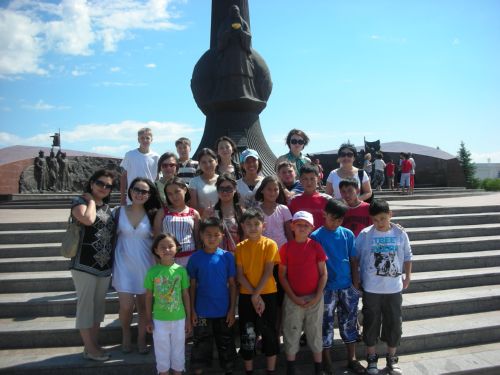
From the outside, “Nur” resembles a large anthill. Children are everywhere. Some draw, dance, and sing in the assembly hall; others conduct experiments and do their homework in the classroom. They come from different backgrounds and different nationalities, yet live together peacefully and as one family under a single shanyrak.
A festive program will be prepared for the family home’s 20th anniversary. But the main task is to carry out a major renovation of the building, which has not undergone a proper overhaul for more than three decades. Anuarbek Baysarin points to the peeling walls covered with cracks and stains:
“First of all, we need to carry out finishing work — repair the electrical wiring, replace the tiles, railings, and floors, and plaster the walls and ceilings,” the guardian explains. “Then we will renovate the bedrooms, assembly hall, dining room, and kitchen. Preliminary estimates put the cost at around 5 million tenge, including both construction materials and the work of a construction crew. When we moved here in 1998, we carried out some minor cosmetic repairs. But since then, the building has deteriorated, and the windows, doors, plumbing, and other facilities have fallen into disrepair…”
The state provides the children with social benefits, but the money is not spent here; it is saved for their further education. Each child will eventually receive a profession, making these savings an investment in their future. The older generation of “Nur” alumni, after graduating from schools, universities, and colleges, now live independently: they have started families and are raising children of their own. But some, after reaching adulthood, remain at the home where they grew up. For them, the foster parents dream of building two apartment buildings. Fortunately, the local akimat has allocated a one-hectare plot of land to the children’s home.
“We want our graduates to have the opportunity to build their own lives, so that when they grow up they do not have to move from one rented corner to another,” explains Tuyak-apai. “I believe there are many kind people among us, and with their help we will be able to make this project a reality.”
Despite the lack of stable funding, this remarkable couple does not lose heart. They give parental love to children who have been abandoned and, through their own example, teach others compassion and kindness.
All that remains is to hope that the “Nur” children’s home will celebrate its anniversary in a fully renovated building that has finally undergone a complete overhaul.